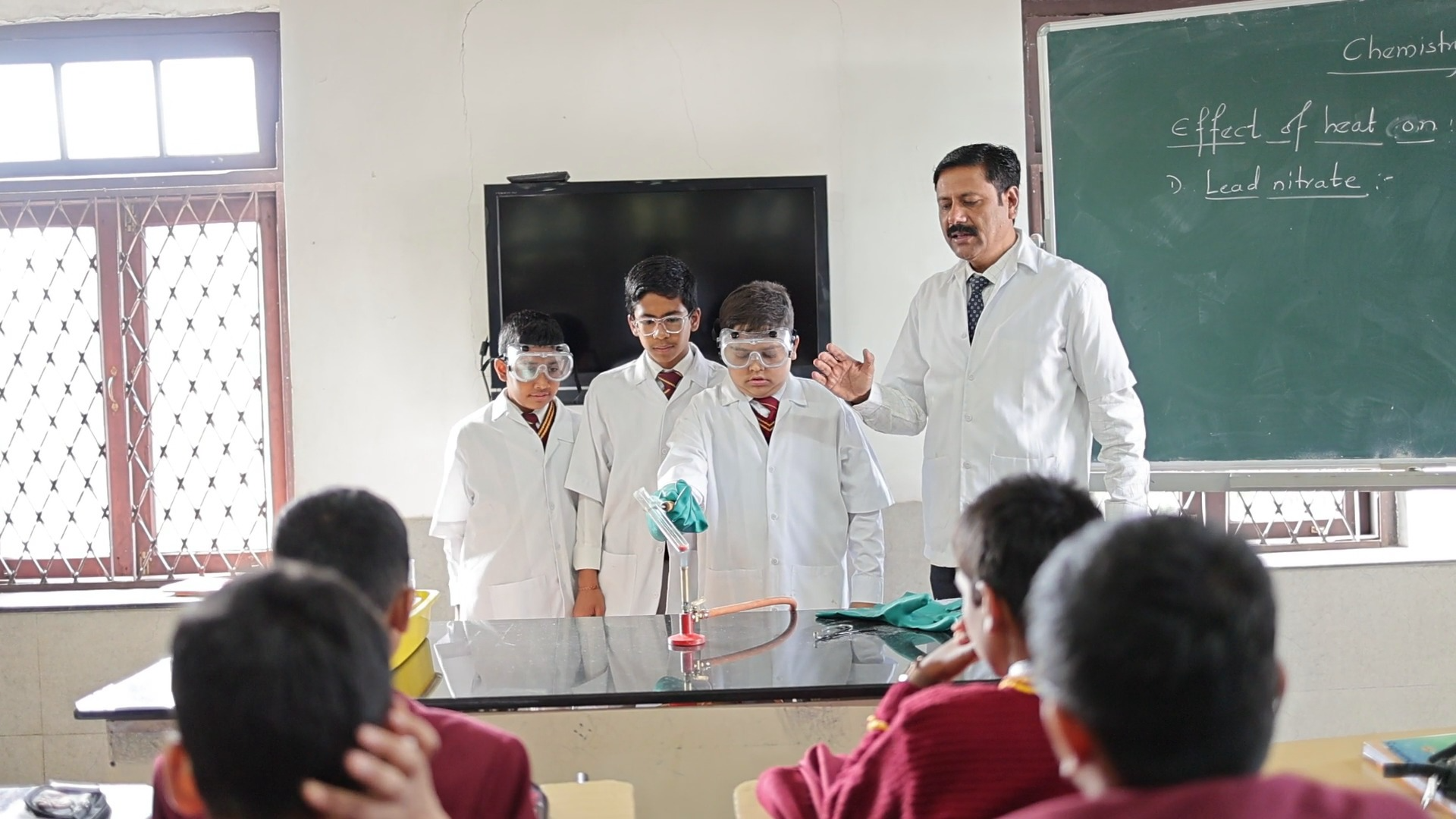
St. Peter’s follows the curriculum prescribed by the Council for the Indian School Certificate Examinations (CISCE), from the primary years through ICSE to the senior school. Languages, laboratory work, computers, creative subjects and physical education travel alongside the core — because a syllabus completed is not the same thing as a mind trained.
What do we actually want from a St. Peter’s graduate? Clear concepts rather than memorised answers. The ability to write and speak persuasively. Analytical habits that transfer to unfamiliar problems. Practical competence with hands as well as head. As students move up the school, teaching grows more specialised, and we guide each one carefully through subject choices, board examinations and the pathways beyond.
In this section
The learning journey
| Stage | Academic focus — and the growth beside it |
|---|---|
| Primary (I–V) | Literacy, three languages, numeracy, environmental and general science, social understanding — with computers, art, music, PE, and the reading habit. |
| Middle (VI–VIII) | Subject-based learning across languages, mathematics, sciences, history and civics, geography — with laboratory habits, projects, teamwork and study skills. |
| ICSE (IX–X) | Compulsory subjects plus approved Group II and III choices — with examination readiness, independent study and career awareness. |
| Senior (XI–XII) | The published programme includes English, Commerce, Accounts, Business Studies and SUPW with Community Service — with higher-order thinking, university guidance and leadership. |
How we support every learner
- Supervised evening study for boarders, so homework happens — consistently, and with help nearby.
- Learning support for students who need a different pace or approach.
- Competitive-examination foundations from the middle years for aspiring engineers and doctors.
- Libraries, laboratories and teachers who stay curious about their own subjects.